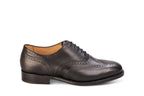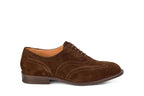
Oxford City Suede Brogues
"A beautifully made shoe, with the extra availability of wider fittings. The darker Chocolate colouring is useful for more formal occasions; a great shoe, all round!"
Free standard shipping on orders over £100
An Oxford shoe is defined by its “closed” lacing system, meaning that its eyelet tabs are stitched underneath the vamp (i.e., the top) of the shoe so that they aren’t visible. Oxfords are occasionally called Balmorals after Balmoral Castle. The shoes are named Oxfords after Oxford University. This shoe style did not appear in North America until the 1800s. In the United States, Oxfords are called "Bal-type" as opposed to "Blucher-type" (see Derby). In France, Oxfords are known as Richelieu.
Oxfords were derived from the Oxonian, a half-boot with side slits that gained popularity at Oxford University in 1800. Oxfords were cut smaller than the foot. The side slit evolved into a side lace that eventually moved to the instep, as students rebelled against knee-high and ankle-high boots. The toe cap can either be lined with two narrow rows of stitching, perforated holes along the end cap stitching (quarter-brogue), perforated holes along the end cap stitching and on the toe cap (semi-brogue), or a semi-brogue with the classical wingtip design (full-brogue).
The Balmoral is also known as an Oxford with no seams, apart from the toe cap seam, descending to the welt. Oxford shoes are also known by their variation, or style. The Cap-Toe Oxford is the most well-known, although 'Whole Cut', 'Plain Toe', and a variation of 'Brogue' Oxfords are common. Shoes with closed lacing (Oxfords/Balmorals) are considered more formal than Derby’s.
The uppers have been created in Repello Suede, perfect for comfort and style whilst being durable - these hides have been treated with a guard during tanning to provide resistance to staining.
Repello Suede is a fine nap suede made from calfskin. The hide is split and aniline-dyed to create a velvety effect on both sides of the leather. The repello suede used in Tricker’s footwear is a range of high quality, tanned to give a full, generous handle and rich appearance.
Fully treated with ‘Scotch Guard’ in the tannage, to achieve a high degree of resistance to staining in general. The proofing remains effective throughout the life of the footwear.
Need more help? Try our Live Chat.
This last 6038 has been used for our City shoes for many years.
We have this product available in multiple width fittings. 5 being the standard width, a 6 fitting for extra width, and 7 fitting for even more.
Need more help? Try our Fit Assistant or contact our Live Chat.
Need more help? Try our Live Chat.
All shoe and boot orders are delivered in plain packaging containing the distinctive blue Tricker's shoe box and complete with a complimentary Tricker's shoe bag and polishing cloth.
For orders of £100 and over:
UK: 1-2 working days - Free Delivery
EU: 2-5 working days - Free Delivery
USA: 1-5 working days - Free Delivery
Japan: 3-7 working days - £25.00 Delivery
Hong Kong: 3-7 working days - £25.00 Delivery
Rest of World: 3-7 working days - Free Delivery
For orders below £100 (UK £50):
UK: 1-2 working days - £3.50
EU: 2-5 working days - €25.00 Delivery
USA: 1-5 working days - £25.00 Delivery
Rest of World: 3-7 working days - £25.00 Delivery
For more details, please see our Delivery & Returns Guide.
Need more help? Try our Live Chat.
Adding product to your cart
An Oxford shoe is defined by its “closed” lacing system, meaning that its eyelet tabs are stitched underneath the vamp (i.e., the top) of the shoe so that they aren’t visible. Oxfords are occasionally called Balmorals after Balmoral Castle. The shoes are named Oxfords after Oxford University. This shoe style did not appear in North America until the 1800s. In the United States, Oxfords are called "Bal-type" as opposed to "Blucher-type" (see Derby). In France, Oxfords are known as Richelieu.
Oxfords were derived from the Oxonian, a half-boot with side slits that gained popularity at Oxford University in 1800. Oxfords were cut smaller than the foot. The side slit evolved into a side lace that eventually moved to the instep, as students rebelled against knee-high and ankle-high boots. The toe cap can either be lined with two narrow rows of stitching, perforated holes along the end cap stitching (quarter-brogue), perforated holes along the end cap stitching and on the toe cap (semi-brogue), or a semi-brogue with the classical wingtip design (full-brogue).
The Balmoral is also known as an Oxford with no seams, apart from the toe cap seam, descending to the welt. Oxford shoes are also known by their variation, or style. The Cap-Toe Oxford is the most well-known, although 'Whole Cut', 'Plain Toe', and a variation of 'Brogue' Oxfords are common. Shoes with closed lacing (Oxfords/Balmorals) are considered more formal than Derby’s.
The uppers have been created in Repello Suede, perfect for comfort and style whilst being durable - these hides have been treated with a guard during tanning to provide resistance to staining.
Repello Suede is a fine nap suede made from calfskin. The hide is split and aniline-dyed to create a velvety effect on both sides of the leather. The repello suede used in Tricker’s footwear is a range of high quality, tanned to give a full, generous handle and rich appearance.
Fully treated with ‘Scotch Guard’ in the tannage, to achieve a high degree of resistance to staining in general. The proofing remains effective throughout the life of the footwear.
Need more help? Try our Live Chat.
This last 6038 has been used for our City shoes for many years.
We have this product available in multiple width fittings. 5 being the standard width, a 6 fitting for extra width, and 7 fitting for even more.
Need more help? Try our Fit Assistant or contact our Live Chat.
Need more help? Try our Live Chat.
All shoe and boot orders are delivered in plain packaging containing the distinctive blue Tricker's shoe box and complete with a complimentary Tricker's shoe bag and polishing cloth.
For orders of £100 and over:
UK: 1-2 working days - Free Delivery
EU: 2-5 working days - Free Delivery
USA: 1-5 working days - Free Delivery
Japan: 3-7 working days - £25.00 Delivery
Hong Kong: 3-7 working days - £25.00 Delivery
Rest of World: 3-7 working days - Free Delivery
For orders below £100 (UK £50):
UK: 1-2 working days - £3.50
EU: 2-5 working days - €25.00 Delivery
USA: 1-5 working days - £25.00 Delivery
Rest of World: 3-7 working days - £25.00 Delivery
For more details, please see our Delivery & Returns Guide.
Need more help? Try our Live Chat.
An Oxford shoe is defined by its “closed” lacing system, meaning that its eyelet tabs are stitched underneath the vamp (i.e., the top) of the shoe so that they aren’t visible. Oxfords are occasionally called Balmorals after Balmoral Castle. The shoes are named Oxfords after Oxford University. This shoe style did not appear in North America until the 1800s. In the United States, Oxfords are called "Bal-type" as opposed to "Blucher-type" (see Derby). In France, Oxfords are known as Richelieu.
Oxfords were derived from the Oxonian, a half-boot with side slits that gained popularity at Oxford University in 1800. Oxfords were cut smaller than the foot. The side slit evolved into a side lace that eventually moved to the instep, as students rebelled against knee-high and ankle-high boots. The toe cap can either be lined with two narrow rows of stitching, perforated holes along the end cap stitching (quarter-brogue), perforated holes along the end cap stitching and on the toe cap (semi-brogue), or a semi-brogue with the classical wingtip design (full-brogue).
The Balmoral is also known as an Oxford with no seams, apart from the toe cap seam, descending to the welt. Oxford shoes are also known by their variation, or style. The Cap-Toe Oxford is the most well-known, although 'Whole Cut', 'Plain Toe', and a variation of 'Brogue' Oxfords are common. Shoes with closed lacing (Oxfords/Balmorals) are considered more formal than Derby’s.
This last has been developed for our City collection and features are squarer toe shape with a slim profile, however, We have this product available in multiple width fittings. 5 being the standard width, a 6 fitting for extra width, and 7 fitting for even more. If you are unsure of your UK size, use our size guide to convert your known size to a UK size. The last is a hard, three-dimensional form on which the shoe is constructed. Depending on the style of shoe we use different lasts, this is what dictates the overall shape, proportion, fit and character of the shoe.
Repello Suede, a fine nap suede made from calfskin. The hide is split and aniline-dyed to create a velvety effect on both sides of the leather. The repello suede used in Tricker’s footwear is high quality, tanned to give a full, generous handle and rich appearance.
Fully treated with ‘Scotch Guard’ in the tannage, to achieve a high degree of resistance to staining in general. The proofing remains effective throughout the life of the footwear.
We advise using a suede brush to help with the aftercare for these shoes.
10 min watch | The Construction Process
Overall rating: 5.0 / 5 from 1 reviews.
Review topics: [].
"A beautifully made shoe, with the extra availability of wider fittings. The darker Chocolate colouring is useful for more formal occasions; a great shoe, all round!"
— Adrian T. (5/5)
It's inevitable that shoes will need a bit of TLC from time to time but look after them and they will last you a lifetime. We offer a fully inclusive repair service from re-heeling to total makeovers.
Our uncompromising standards of craftsmanship, honest materials, environmentalism and sustainability are values that have been preserved and developed through five generations.
Every material used in our construction can be traced back to its source.
Every pair of Tricker’s shoes and boots is 100% made in Northampton, the historic centre of British shoemaking. From cutting the leather to the final polish, each stage takes place under one roof at our St Michael’s Road factory, following a time-honoured process refined over generations. It’s here that traditional skills, patience and precision come together, ensuring every pair carries the integrity, durability and character that Northampton-made footwear is known for.
Note: Advice for the last. Recommendations vary by shoe model.